UPDATE: Regrettably the creator of the map described in this post has discontinued the map website. Thank you for your hard work, anonymous map-maker. The federal government data that were used to make the map, and that are regularly updated, are posted here.
__________________________________
In the last few weeks, there has been a lot of discussion around the Canadian federal government’s Temporary Foreign Worker (TFW) program. This program allows eligible employers to hire temporary workers from outside Canada. To be eligible to hire a TFW, an employer usually has to obtain a “positive” Labour Market Impact Assessment (LMIA), which is a confirmation that the employer cannot find qualified Canadian workers to fill its vacant job. A worker entering Canada on a TFW permit can only work for the employer that received the LMIA for the job.
Part of the reason for the increased attention to the TFW program is the release of a new report commissioned by the United Nations’ Human Rights Council. The report calls the TFW program “a breeding ground for contemporary forms of slavery”. It alleges that employers having control over TFWs’ immigration status in Canada leads to worker exploitation and abuse, with workers afraid to report mistreatment for fear of being fired and deported. It’s also been suggested that Canadian employers turn to using TFWs when they aren’t willing to pay the higher wage rates that Canadian workers expect.
Other critics of the program have alleged that the LMIA process is being corrupted by unethical employers and immigration agents. These employers create non-existent jobs, get positive LMIAs for those jobs, and then, with the help of the agents, “sell” the LMIAs to individual immigrants. The immigrant pays the employer a fee – allegedly often in the tens of thousands of dollars – and the employer hires the immigrant to fill the vacant “job”. The immigrant can then enter Canada as a TFW. Individuals admitted to Canada on a temporary basis may eventually be able to apply for permanent residency (PR), which allows them to legally live and work in Canada.
TFW permits are issued for jobs in different wage and skill categories. However, there are also some questionable trends across and within these categories. The Globe and Mail recently reported that the number of approvals for TFWs in the “administrative assistant” category increased from 112 in 2016 to 3,573 in 2023. There was no indication of any changes in the Canadian labour market that made it necessary to hire that many workers from outside Canada for this type of job.
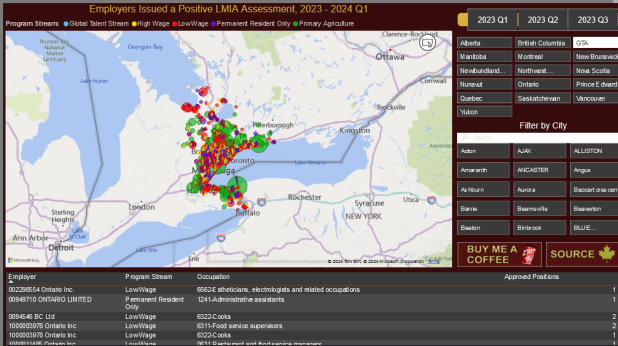
A screenshot of the LMIA Map, showing the employers in and around Toronto that received positive LMIAs in 2023 and early 2024.
I recently came across a very valuable resource that gives a visual illustration of this complex situation – the LMIA Map. An anonymous researcher has used Power BI to build a map showing the locations of businesses in Canada that have received a positive LMIA assessment, allowing them to hire TFWs. The data identifying these businesses are taken from the federal government’s own publicly available reports on LMIA applications and approvals. The researcher says they created the map “because I believe the TFW program needs changes to better protect vulnerable people who travel to Canada, and to limit the potential for exploitation driven by corporate greed”.
The map is searchable by region and city, by reporting period, and by the employment category in which the LMIA was issued. There’s also a section of the map that shows the locations of non-compliant employers; these are employers that have received penalties for violating the terms of the TFW program.
My first reaction in looking at the LMIA Map was shock, seeing the large numbers of businesses that use, or have used, TFWs. I was even more shocked when I found some of the businesses in my own city that are on the map. Obviously I don’t know the circumstances of each business and its workforce, or the requirements of specific jobs within each business. But it seems highly unusual that a South Asian restaurant received an LMIA permitting it to hire four TFWs as cooks – when 37% of the population of a nearby city are of South Asian ethnicity. It would be very interesting to know how this business proved that it could not find four workers in Canada, South Asian or not, who were qualified to cook South Asian restaurant food.
The restaurant in my city is just one of literally thousands of businesses across Canada on the LMIA Map. Undoubtedly some of these businesses have valid reasons to hire TFWs, but some of the data on the map definitely raise questions about whether the TFW program is being used appropriately.
For anyone who is researching or writing about the TFW program, or just generally interested in the program and its implications, the LMIA Map is a very useful tool. It summarizes complex information that is difficult to assess from lengthy Excel spreadsheets (the format that the government presents its data in), and its layout is very easy to navigate. I encourage you to explore it for yourself.
 All About Work
One comment