publishing

Things that Make You Go…Wow

I love art, and I love design. But sadly, I don’t come across a lot of innovative or thoughtful design in the publications I see in my academic work. (I’d like to think that my textbook’s cover design – centered around a wonderful painting by Group of Seven member A.Y. Jackson – is an exception to that norm.)

So when I went to the Association for Studies in Higher Education academic conference this month, at the Cosmopolitan Hotel in Las Vegas, I wasn’t expecting to find good art or good design. But I was very pleasantly surprised (more…)

Malcolm Gladwell’s “10,000 Hour Rule” Doesn’t Add Up

As regular readers of this blog know, it bugs me when writers get things wrong or can’t be bothered to justify their facts. Recently I’ve been seeing a lot of references to the “10,000 hour rule” – the idea that you need to spend 10,000 hours on an activity to be successful at it.  I knew that this idea was popularized by writer Malcolm Gladwell in his book Outliers, but I didn’t know where he got the idea from or what it was based on.

So imagine my surprise when I Googled “10,000 hour rule” and found a letter by K. Anders Ericsson, the lead author of the study that Gladwell cites as “Exhibit A”  in support of the “rule”. (ETA: The full text of the letter is no longer available online, but its contents are described here.) Not only does Ericsson say that Gladwell “invented” the 10,000 hour rule, but he also describes Gladwell  as making a “provocative generalization to a magical number”. (more…)

Best Author Acknowledgement Ever

I just finished reading Guy Walters‘ excellent book Berlin Games: How the Nazis Stole the Olympic Dream. I’ve done research on some of the Canadian groups that organized  resistance to the 1936 Olympics, and so I appreciate Walters’ efforts in preserving some more of the very important history around this event. What happened in and around the 1936 Berlin Games has more influence than we’d like to think on the ceremonies and structures of the Olympics we see now.

The book is extremely well researched and engagingly written, and I very much enjoyed reading it. But what I want to share from the book is one of the best author acknowledgements I’ve ever seen. (more…)

Population Ecology Theory in Real Life: How The Globe and Mail Misunderstood its Environment

This week the Internet has been alive, at least in my part of the world, with the unfolding drama of Globe and Mail columnist Margaret Wente’s alleged plagiarism. Since one of Ms. Wente’s favorite targets is university professors, who she characterizes as grossly overpaid and lazy, and not teaching anything that’s relevant to the real world, I thought I’d use population ecology theory – one of the allegedly irrelevant topics in my Organization Theory course – to analyze why her and her employer’s real-world responses to the plagiarism issue have been so ineffective. (more…)

Jonah Lehrer’s ‘Imagine’: How Did This Happen?

This past week, I had the opportunity to read Jonah Lehrer’s Imagine –  the book that’s part of the controversy about plagiarism and fabrication in Lehrer’s writing. Imagine has been pulled by its publisher as a result of that controversy, so pointing out additional problems with it may now be somewhat redundant. (The copy I read came from my public library.) Nevertheless, after reading it, I want to outline the problems I found with the referencing in the book – an area which other commentators have also raised concerns about. (more…)

Wired Magazine “Severs Relationship” with Jonah Lehrer

Earlier today, the Slate website released this analysis of Jonah Lehrer’s work for Wired magazine and its website. Wired commissioned the analysis after previous work by Lehrer published elsewhere was revealed to have been plagiarized or recycled – but, according to the report’s author, Charles Seife, “Wired.com decided not to publish my full analysis of my findings”.

Several hours after the report was posted on Slate, Wired announced that its relationship with Lehrer has been severed. (more…)

The Lehrer Case, Part III: Being Unethical To Be Successful

I’ve written a few posts already about the Jonah Lehrer story – the case of the writer whose self-plagiarism episode blew up into a case of outright fabrication.  This story fascinates me because of what it says about how modern media organizations operate, how writing careers work, and more broadly, about another theme that I’ve also touched on before – definitions of “success”. (more…)

Update: “Self-Plagiarising” Writer Admits to Fabricating Quotes

Jonah Lehrer, the New Yorker columnist I wrote about here in relation to the issue of “self-plagiarism” in writing, has resigned from his position at The New Yorker. According to this story, he was accused of, and has admitted to, fabricating quotes from Bob Dylan – ironically (or maybe not) in Imagine, his book on creativity. Here’s the story with the details of the fabricated quotes.

It will be very interesting to see how this plays out, and whether this discovery is just the tip of the iceberg as to what else might be unreliable in Lehrer’s work. As I discussed in my previous post, I have more of a problem with his inaccurate reporting than with his self-plagiarism. But there’s no question that making stuff up is wrong – and with Lehrer’s high profile and prodigious output, his past work will now be much more closely and critically scrutinized. It looks like Imagine has already been pulled from some sales outlets. I have a feeling that the story isn’t going to end here.

After “The Word”….it’s The Afterword!

I recently wrote about the closure of the very fine British music magazine The Word. Two days ago, the magazine’s website also ceased doing business, although the site is maintaining an archive of all of The Word podcasts (which are well worth listening to).

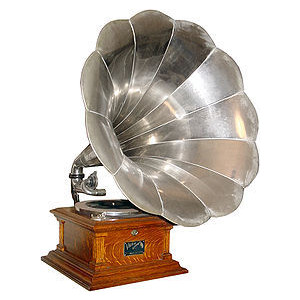
The phonograph is part of The Afterword’s logo. (Credit: Wikipedia)

However, a dedicated group of the Word’s readers and website participants – known collectively as The Word Massive – have decided to attempt to continue the broad cultural coverage, the wit, and the fine writing that made The Word so exceptional. Their website, The Afterword, has just launched, and it’s excellent. It has many of the same features that made The Word website so lively –  and, as demonstrated by this post asking for volunteer moderators,  the volume of activity on the site has been far beyond anyone’s expectations.

The dedication and professionalism that’s evident on The Afterword shows the impact that The Word had on its readers during its nine years in print. It will be interesting to see how The Afterword evolves – other reader-initiated sites, like The Blizzard, have been able to find a niche, and to survive financially, by finding audiences that appreciate good writing and broad-ranging discussion.
Please visit The Afterword and take a look at what’s happening. I think you’ll be impressed.
Misreporting is Worse than ‘Self-Plagiarism’

In the last few weeks, science writer Jonah Lehrer has been under fire in media circles for “self-plagiarism”. A number of investigators have discovered close similarities or identical wording in the texts of articles and speeches he’s written or delivered. However, there’s another aspect of the Lehrer situation that I find more concerning than the allegations of “self-plagiarism” – and that’s the alleged errors in his reporting about scientific research. (more…)