human resource management

Race, Class, and Bias in Hiring

At the start of a new year, a lot of people make resolutions for what they want to achieve in the next twelve months – and often those resolutions have something to do with work. The resolution could be to choose a new career, to get more education, or to look for a new job. So now is a particularly appropriate time to look at two recent studies about bias in employers’ hiring processes. The results of these studies demonstrate that job applicants can often be rejected for reasons that have absolutely nothing to do with their ability to do the job. And the studies also suggest that biased hiring has effects that go way beyond individual careers or workplaces.

These two studies used essentially the same methodology, which is (more…)
Shadow Work and Customer Service

In any organization, there are tasks that have to be done if anything is going to be accomplished or produced. So the organization has to decide which jobs in the organization are responsible for completing those tasks. In workplaces, this decision process is referred to as “job design” – putting different tasks together to create jobs.

Ideally, according to job characteristics theory, a job has skill variety, task significance (feeling like the task contributes something meaningful), autonomy, and the opportunity to get performance feedback. All of these make the job enjoyable for the worker who has that job. The organization also has to ensure that the tasks in one job don’t overlap with or duplicate tasks in other jobs, and that all the tasks in the organization are assigned to a job.

However, tasks in a workplace are not always easy to fully define, or to fit inside clear boundaries. Think of something like (more…)

Job Churn and Precarious Work

I wrote an opinion article for the Report on Business section of the Globe and Mail newspaper, responding to recent comments by Canadian politicians that workers should “get used to” job churn and precarious work. You can read the article here.

University Diversity

Diversity in the workforce is a challenging issue for many organizations, but it’s particularly critical for universities. This is partly because many universities are publicly funded, which might imply that they have a larger responsibility to represent the population that financially supports them. And universities that teach about inclusivity and equality should surely be expected to live those values in their own operations.

But another reason is that universities are large and very visible organizations. Unlike workers at companies whose operations are largely unseen, workers at universities interact with large numbers of people – students, communities, governments – every day. So if there is a lack of diversity in the workforce at universities, it will be far more noticeable than it might be in other types of organizations.

Statistics Canada collects data on gender diversity among post-secondary instructors, but it doesn’t collect data on racial, ethnic or international diversity in that occupation. So I was very interested in (more…)

Graduate Degrees and Low-Wage Work

Underemployment is a phenomenon in the labour market that doesn’t get a lot of attention. That’s partly because the term “underemployment” can mean a couple of different things. One definition of “underemployment” is part-time workers who would prefer to be working full-time, or who are actively seeking full-time work while working part-time. Those situations aren’t always captured by measures that simply count the numbers of part-time workers, because those data don’t look at workers’ reasons why they are working part-time.

Another definition of “underemployment” is workers that have higher qualifications than the requirements of the job they’re employed in. This is also referred to as “overqualification”. And there’s a new study with some fascinating data about underemployment or overqualification among people with graduate degrees. (more…)

What unemployment at 63 looks like — Campari & Sofa

A very insightful look at one woman’s experience with late-career unemployment – a perspective that often gets overlooked in reports of corporate downsizing and layoffs.


“It feels like a divorce. 31 years with the same man and then you are abandoned for a younger woman.” The “man” in question is, in fact, a corporation; Mattel,…

via What unemployment at 63 looks like — Campari & Sofa

Letting the Sunshine In

How much light should a “sunshine list” shine?

Public sector compensation disclosure lists – “sunshine lists” – are lists of individuals in public sector jobs that are paid more than a certain amount. These annual lists usually include the person’s name, the public sector organization they work for, their job title, and their annual earnings for that fiscal year.  In Canada, five provinces have some version of a legislated “sunshine list”: Alberta, Nova Scotia, Ontario, Saskatchewan, and New Brunswick. (Other provinces publish salary information in their public accounts, but don’t produce a single comprehensive list.)

The reasons for publishing these lists usually involve “accountability” and “transparency” – but recently there has been pushback from some of the workers included on the lists. (more…)

“Passion”

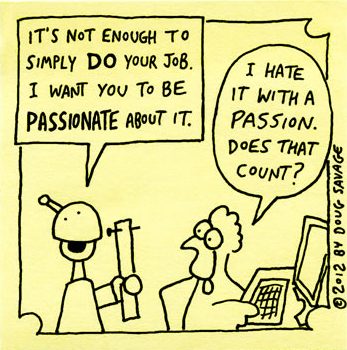
On networking sites like LinkedIn, and in biographies for keynote speakers – and in way too many other work-related contexts – it’s now almost obligatory for people to state their “passion”. However, these “passions” are, in many cases, so generic as to be meaningless – seriously, who doesn’t want to do something like make other people happy? And many statements of “passion” are often so jargon-laden that it’s difficult to tell exactly what the person gets excited about.

I was going to write a post about the awful superficiality of this expectation to be “passionate”. But then I came across a post on the same topic by Mark Manson. He says everything I was going to say – and he expresses it with genuine passion. Enjoy!


Conferences and Codes of Conduct

Nearly every organization has a code of conduct for its employees. These codes are usually explicit rules about what the organization’s members are and aren’t allowed to do, including the penalties – from reprimands to firing – for breaking those rules. Often there are also statements of the organization’s guiding values and principles, which employees are expected to uphold in carrying out their work or making decisions. But when employees go to professional events like conferences – events related to work but which take place outside the workplace – the rules of behaviour aren’t always as clear.

Behaviour at conferences is something that I’ve been thinking about as conference season is starting for me. Every year, away from the watchful eyes of their supervisors and their human resources department, some people act like idiots. They might do things like ask questions during a seminar or presentation with the sole intention of making the presenter look bad and making themselves look good. Or they might harass other conference attendees, usually at social events, by doing things like looking down women’s tops, making inappropriate comments about how someone is dressed, or uttering racist or sexist insults (I’ve personally witnessed all of these).

Surprisingly, though, many conference organizers are reluctant to crack down on these kinds of behaviours by attendees. (more…)

Feedback at Work

Giving feedback – to employees, peers, or even bosses – is a tricky but essential process in almost every organization. It’s important to let people know how they’re doing in their work, but it’s often difficult to figure out the best way to tell them, especially if there are problems with their performance.  And we all know organizations that loudly proclaim how much feedback and improvement are valued in their workplaces, but that don’t actually do much to make those processes happen.

My friend Allison Manley has recently starting hosting a podcast for Palantir.net, the web design, development and strategy firm where she works. The most recent episode of the podcast has a fascinating discussion on the topic of feedback. Allison talks with Colleen Carroll, Palantir’s director of operations, about Palantir’s commitment to having a “culture of feedback” and how the company actually makes that happen. What I found particularly interesting about this discussion is that it doesn’t repeat any of the usual clichés about feedback, like “focus on the problem, not the person”, and that it emphasizes the role of the sender of the feedback – a part of the process that often gets overlooked. Here are some of Colleen’s thoughtful insights into what makes feedback work. (more…)