business

“Passion”

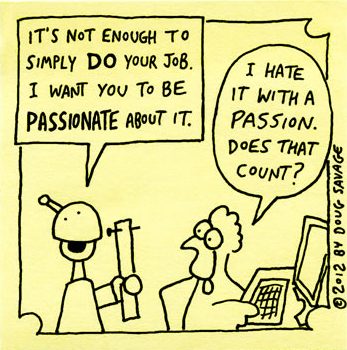
On networking sites like LinkedIn, and in biographies for keynote speakers – and in way too many other work-related contexts – it’s now almost obligatory for people to state their “passion”. However, these “passions” are, in many cases, so generic as to be meaningless – seriously, who doesn’t want to do something like make other people happy? And many statements of “passion” are often so jargon-laden that it’s difficult to tell exactly what the person gets excited about.

I was going to write a post about the awful superficiality of this expectation to be “passionate”. But then I came across a post on the same topic by Mark Manson. He says everything I was going to say – and he expresses it with genuine passion. Enjoy!


Misreading the Environment, Part II

Nearly four years ago, I wrote this blog post about how the Globe and Mail newspaper responsed to allegations that columnist Margaret Wente had used uncredited sources in some of her writing. In that post, I talked about the model of population ecology, from organizational theory. The model suggests that if an organization wants to be considered legitimate, and to gain benefits of legitimacy such as resources and power, then it needs to monitor cues in its external environment, and respond to those cues in ways that the environment considers appropriate.

Wente was briefly suspended after those 2012 allegations, but returned to her job. This past week, the same blogger that found problems with Wente’s work in 2012 found uncredited material from other sources in Wente’s most recent column. The Globe‘s response to these findings was to publish a column by its public editor.  The column quoted the Globe‘s editor-in-chief as saying the paper would “work with Peggy to ensure this cannot happen again”, and that there would be apologies and corrections to the uncredited material.

After that, in Lewis Carroll’s words, “answer came there none” – despite (more…)

Sigh…..

Mansplaining Event at PayPal via Francine Lipman (@Narfnampil) Feminist Law Professors

via Mansplaining Event at PayPal — Feminist Law Professors

20 Years of ‘Heavy’: An Interview with Eric Matthews

In 1995, there was an “adult alternative” radio station in Bellingham, Washington – just south of the Canadian border – that played pretty much everything and anything. One day when I was listening to this station on my car radio, I heard a song called ‘Fanfare’. The song was so distinctive and powerful that I knew I had to get the record – but I missed the name of the artist.

I went to the largest record store in downtown Vancouver and asked one of the staff, “Do you know a song called ‘Fanfare’?” His face absolutely lit up, and he said, “Do we ever. We love that song!” And he handed me a copy of It’s Heavy In Here by someone named Eric Matthews. The album was on Seattle’s Sub Pop label, but the cover photo showed a neatly groomed and stylishly dressed young man – the complete opposite of the beard-and-dirty-flannel grunge that Sub Pop was famous for. It was then that I knew I had found something very different and very special.

After writing about music for nearly 30 years, I can’t really clearly articulate why I love It’s Heavy in Here and ‘Fanfare’ so much. It’s Heavy in Here is an unconventional album in many ways, with its non-linear lyrics and ornate instrumentation. But instead of coming off as self-indulgent, it’s a grandly confident and fully realized individual vision. ‘Fanfare’ is both intimate and epic at the same time, and its emotional vulnerability and honesty are profoundly moving.

Matthews released one other album on Sub Pop, and then seemed to pop up every few years with a new project, in addition to guesting with other artists such as the Dandy Warhols – that’s him playing the trumpet on ‘Godless’ – and Pugwash. A couple of months ago, on a whim, I searched Matthews’ name on Google to see what he was up to. Much to my delight, I found that It’s Heavy in Here was being re-released for its 20th anniversary, and that Matthews had joined a band named SheLoom that was just releasing a new record. And not only did Matthews have a Facebook account, but he also responded to messages through that account. I was thrilled when he agreed to be interviewed about the process of creating the It’s Heavy in Here re-release. (more…)
Book Publishing and False Economies

The North American book publishing industry has been disrupted in the last couple of years. Publishers’ revenues are dropping for a number of reasons:  different publishing formats, the increased ease of self-publishing, and upheavals in distribution and sales channels. And in any business, when revenues decrease, one of the first strategic responses is usually to reduce production costs. For book publishers, that can mean reducing the costs of editing or proofreading in the book production process. But cutbacks in those areas can be a false economy, if those cutbacks significantly affect the quality of the finished product. And this week I received a review copy of a book that perfectly illustrates that dilemma.
(more…)

“Follow Your Heart”: An Interview with Jim Pons

The start of a new year, along with all the “New Year, New You” encouragement, usually leads people into thinking about making changes. One kind of change that’s often considered is a new job or a new occupation – but that can be a pretty scary leap into the unknown, especially when there’s cutbacks and downsizing going on at many formerly prosperous companies.

I thought that it would be interesting to interview someone who made that big leap and had it work out for them. After some asking around, my friend John Cody offered to connect me to Jim Pons, who is a wonderful example of this kind of career transition. Jim is a bass player and vocalist, and was part of three major bands in the 1960s and early 1970s – the Leaves, the Turtles,  and the Mothers of Invention. But he quit the music industry in 1973, and embarked on a career in video production with the National Football League, first with the New York Jets team and then with the Jacksonville Jaguars. Jim has recently written his autobiography, and generously agreed to be interviewed via email about his experiences in changing careers. (more…)

Feedback at Work

Giving feedback – to employees, peers, or even bosses – is a tricky but essential process in almost every organization. It’s important to let people know how they’re doing in their work, but it’s often difficult to figure out the best way to tell them, especially if there are problems with their performance.  And we all know organizations that loudly proclaim how much feedback and improvement are valued in their workplaces, but that don’t actually do much to make those processes happen.

My friend Allison Manley has recently starting hosting a podcast for Palantir.net, the web design, development and strategy firm where she works. The most recent episode of the podcast has a fascinating discussion on the topic of feedback. Allison talks with Colleen Carroll, Palantir’s director of operations, about Palantir’s commitment to having a “culture of feedback” and how the company actually makes that happen. What I found particularly interesting about this discussion is that it doesn’t repeat any of the usual clichés about feedback, like “focus on the problem, not the person”, and that it emphasizes the role of the sender of the feedback – a part of the process that often gets overlooked. Here are some of Colleen’s thoughtful insights into what makes feedback work. (more…)

Universities, Governance, and Conflict

It’s been a turbulent time recently in British Columbia’s post-secondary education system. In August, Arvind Gupta, the president of the University of British Columbia (UBC), suddenly resigned less than one year into his appointment. A UBC faculty member was criticized for a blog post she wrote about the resignation; that criticism resulted in an investigation which determined that UBC had failed to protect her academic freedom. After the report from the investigation was released, the chair of UBC’s Board of Governors stepped down from his position. But then an inadvertent leak of documents by UBC reignited the controversy, and Gupta spoke out to say that he chose to resign because he felt he did not have the support of the board.

Meanwhile, in December, the University of Northern British Columbia (UNBC) announced that its new chancellor – the ceremonial head of the university – would be James Moore, a former federal Member of Parliament and federal cabinet minister. Moore’s appointment was opposed by the UNBC faculty association, UNBC’s two student associations, and two thousand signatories to a petition, including several members of UNBC’s Senate. They complained that Moore had been a key part of a government that had muzzled scientific research and ignored climate change, and that some of Moore’s own actions went against the values and principles in UNBC’s mission statement. Despite the assurances of the chair of the UNBC Board of Governors that the board was “listening” to these concerns, Moore’s appointment was finalized in January.

These events have generally been framed by the media as a “they said”/”they said” scenario, with two different narratives struggling to become the one that’s accepted as the truth. Presenting the conflicting points of view is important in understanding why these disputes have arisen. But the “they said”/”they said” perspective omits the contextual picture: specifically, (more…)

Employee Engagement Surveys (And Doing Them Well)

2015 was a really bad year for the Canadian Broadcasting Corporation (CBC). At the start of the year, business correspondent Amanda Lang was accused of being in a conflict of interest for her reporting on an issue involving the Royal Bank of Canada while having a personal relationship with a RBC executive. (Lang later left the CBC for a new job with Bloomberg TV.) Then radio host Jian Ghomeshi lost his job because of incidents that resulted in him being charged with one count of choking and five counts of sexual assault – and CBC management’s awkward handling of that situation led to the firing of two top executives. And then TV host Evan Solomon was fired after allegations that he exploited his work-related connections to sell high-priced artworks. (He found a new job on satellite radio and as a magazine columnist.)

There was one bright spot for the CBC in October when the decidedly anti-CBC Conservative party was defeated in the Canadian federal election. The potential for change in the CBC’s relationship with Canada’s federal government, which funds the CBC’s operations, was characterized by retired CBC journalist Linden MacIntyre as “the people that are the custodians of this publicly owned institution no longer seem[ing] to hate it” – but the CBC is still struggling with the fallout from the traumatic events that marred its reputation in the past year.

An external review of the CBC workplace was commissioned after (more…)

This is What We Lose

The new film Spotlight tells the story of an investigation by a team of reporters at the Boston Globe newspaper in the early 2000s. The reporters documented extensive child abuse by priests and brothers in the Catholic Archdiocese of Boston. Their investigation also exposed a cover-up by church officials, who knew that widespread abuse had been happening for several decades but failed to do anything meaningful to stop it.

I saw Spotlight this week, and I highly recommend it. It’s a fascinating and engaging film. And as a former newspaper reporter, I thought the film very realistically depicted the work of reporting, especially in showing the amount of legwork and detailed research that goes into writing a major news story. It also illustrated the often-overlooked contexts within which news stories develop – in this case, the elites in Boston society that helped to keep the abuse hidden, and that also discouraged the Globe from pursuing the story.

However, as much as I enjoyed Spotlight, it also made me feel very sad – because (more…)