What unemployment at 63 looks like — Campari & Sofa

A very insightful look at one woman’s experience with late-career unemployment – a perspective that often gets overlooked in reports of corporate downsizing and layoffs.


“It feels like a divorce. 31 years with the same man and then you are abandoned for a younger woman.” The “man” in question is, in fact, a corporation; Mattel,…

via What unemployment at 63 looks like — Campari & Sofa

Art that Makes a Difference

As much as I like going to museums and art galleries, I sometimes struggle with the question of what these institutions contribute to the world. And I know museum and gallery professionals struggle with this question too. Sometimes people just need a place where they can look at or interact with something that gives them new ideas or new insights, or makes them see the world in a different way. Museums and art galleries can be that place. But while I certainly disagree with the business-oriented operational model that demands tangible and measurable outcomes – because that model assumes that if it can’t be measured, it doesn’t exist – I do wonder sometimes whether museums and galleries can use their resources to have a more visible impact outside their own walls.

So I was very excited to read about an art exhibition which will have a tangible external impact. (more…)

Selective Attention

At the end of April, Margaret Wente, a columnist for the Toronto-based Globe and Mail newspaper, was accused of plagiarism for the second time. Her column temporarily disappeared, and Globe editor David Walmsley stated that “[t]he Opinion team will be working with Peggy to ensure this cannot happen again”.

Wente’s column started showing up again on the Globe’s editorial pages in mid-May. If her June 11 column is an example of her rehabilitated writing, it looks like Wente might have learned not to plagiarize – but she continues to express opinions that don’t fit the facts.

The column in question pooh-poohs the idea of “quotas for women” to encourage more equitable gender representation in leadership positions. Wente states that “in business circles, it is now conventional to declare that companies with more women on their boards are more socially responsible and tally better financial results”. She then proceeds to attack that idea by citing this recent academic article by researcher Alice Eagly, presenting it as proof that a diverse board of directors does not improve a company’s financial performance or the board’s own effectiveness.

I’m not sure where Wente is finding these “business circles” that believe in diverse board membership. (more…)

Letting the Sunshine In

How much light should a “sunshine list” shine?

Public sector compensation disclosure lists – “sunshine lists” – are lists of individuals in public sector jobs that are paid more than a certain amount. These annual lists usually include the person’s name, the public sector organization they work for, their job title, and their annual earnings for that fiscal year.  In Canada, five provinces have some version of a legislated “sunshine list”: Alberta, Nova Scotia, Ontario, Saskatchewan, and New Brunswick. (Other provinces publish salary information in their public accounts, but don’t produce a single comprehensive list.)

The reasons for publishing these lists usually involve “accountability” and “transparency” – but recently there has been pushback from some of the workers included on the lists. (more…)

“Passion”

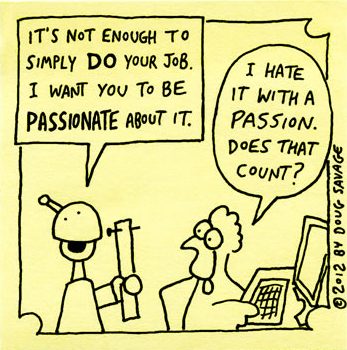
On networking sites like LinkedIn, and in biographies for keynote speakers – and in way too many other work-related contexts – it’s now almost obligatory for people to state their “passion”. However, these “passions” are, in many cases, so generic as to be meaningless – seriously, who doesn’t want to do something like make other people happy? And many statements of “passion” are often so jargon-laden that it’s difficult to tell exactly what the person gets excited about.

I was going to write a post about the awful superficiality of this expectation to be “passionate”. But then I came across a post on the same topic by Mark Manson. He says everything I was going to say – and he expresses it with genuine passion. Enjoy!


Water

Writing a blog is rewarding in many ways. But for me, one of the great and unexpected benefits of blogging is being inspired – even unknowingly – by the work of other bloggers.

This spring, a blog that I’ve really been enjoying is The Perimeter by photographer Quintin Lake. Quintin has done several long-distance walks in the UK, but last year he embarked on an epic journey – a walk around 10,000 kilometres of Britain’s coastline. He’s doing the walk in sections, as time permits; he estimates he’ll get back to his starting point (St. Paul’s Cathedral in London) in April 2020.

In the last couple of weeks, I’ve had some unusual opportunities to take photos – including a round trip by seaplane from Vancouver to Nanaimo. I found that for some reason my eye kept being drawn to water: its textures, its movement, how the light made it change. And I ended up taking a lot of pictures of it. But it wasn’t until a few days ago, (more…)

Misreading the Environment, Part II

Nearly four years ago, I wrote this blog post about how the Globe and Mail newspaper responsed to allegations that columnist Margaret Wente had used uncredited sources in some of her writing. In that post, I talked about the model of population ecology, from organizational theory. The model suggests that if an organization wants to be considered legitimate, and to gain benefits of legitimacy such as resources and power, then it needs to monitor cues in its external environment, and respond to those cues in ways that the environment considers appropriate.

Wente was briefly suspended after those 2012 allegations, but returned to her job. This past week, the same blogger that found problems with Wente’s work in 2012 found uncredited material from other sources in Wente’s most recent column. The Globe‘s response to these findings was to publish a column by its public editor.  The column quoted the Globe‘s editor-in-chief as saying the paper would “work with Peggy to ensure this cannot happen again”, and that there would be apologies and corrections to the uncredited material.

After that, in Lewis Carroll’s words, “answer came there none” – despite (more…)

Sigh…..

Mansplaining Event at PayPal via Francine Lipman (@Narfnampil) Feminist Law Professors

via Mansplaining Event at PayPal — Feminist Law Professors

Conferences and Codes of Conduct

Nearly every organization has a code of conduct for its employees. These codes are usually explicit rules about what the organization’s members are and aren’t allowed to do, including the penalties – from reprimands to firing – for breaking those rules. Often there are also statements of the organization’s guiding values and principles, which employees are expected to uphold in carrying out their work or making decisions. But when employees go to professional events like conferences – events related to work but which take place outside the workplace – the rules of behaviour aren’t always as clear.

Behaviour at conferences is something that I’ve been thinking about as conference season is starting for me. Every year, away from the watchful eyes of their supervisors and their human resources department, some people act like idiots. They might do things like ask questions during a seminar or presentation with the sole intention of making the presenter look bad and making themselves look good. Or they might harass other conference attendees, usually at social events, by doing things like looking down women’s tops, making inappropriate comments about how someone is dressed, or uttering racist or sexist insults (I’ve personally witnessed all of these).

Surprisingly, though, many conference organizers are reluctant to crack down on these kinds of behaviours by attendees. (more…)

20 Years of ‘Heavy’: An Interview with Eric Matthews

In 1995, there was an “adult alternative” radio station in Bellingham, Washington – just south of the Canadian border – that played pretty much everything and anything. One day when I was listening to this station on my car radio, I heard a song called ‘Fanfare’. The song was so distinctive and powerful that I knew I had to get the record – but I missed the name of the artist.

I went to the largest record store in downtown Vancouver and asked one of the staff, “Do you know a song called ‘Fanfare’?” His face absolutely lit up, and he said, “Do we ever. We love that song!” And he handed me a copy of It’s Heavy In Here by someone named Eric Matthews. The album was on Seattle’s Sub Pop label, but the cover photo showed a neatly groomed and stylishly dressed young man – the complete opposite of the beard-and-dirty-flannel grunge that Sub Pop was famous for. It was then that I knew I had found something very different and very special.

After writing about music for nearly 30 years, I can’t really clearly articulate why I love It’s Heavy in Here and ‘Fanfare’ so much. It’s Heavy in Here is an unconventional album in many ways, with its non-linear lyrics and ornate instrumentation. But instead of coming off as self-indulgent, it’s a grandly confident and fully realized individual vision. ‘Fanfare’ is both intimate and epic at the same time, and its emotional vulnerability and honesty are profoundly moving.

Matthews released one other album on Sub Pop, and then seemed to pop up every few years with a new project, in addition to guesting with other artists such as the Dandy Warhols – that’s him playing the trumpet on ‘Godless’ – and Pugwash. A couple of months ago, on a whim, I searched Matthews’ name on Google to see what he was up to. Much to my delight, I found that It’s Heavy in Here was being re-released for its 20th anniversary, and that Matthews had joined a band named SheLoom that was just releasing a new record. And not only did Matthews have a Facebook account, but he also responded to messages through that account. I was thrilled when he agreed to be interviewed about the process of creating the It’s Heavy in Here re-release. (more…)