How Latvian Mythology Contributed to the Olympic Silver in Bobsleigh

Fascinating insights from the designer of the graphics on Latvia’s Olympic bobsleds. And how great is it that all that attention to detail helped the Latvian bobsled team win a medal!!

Julia Gifford's avatarFood, writing, random musings, and everything I enjoy

These past Olympics have been mind-blowing for the Latvians. A very small country, with the third most medals per capita of all participating countries, Latvia also managed to induce partial heart attacks to 35million Canadians with the show-stopping Canada vs. Latvia hockey game, drawing all eyes on Latvia (similarly to the last summer Olympics when Latvia won gold in men’s Volleyball – “Wait, do they even have summer?”)

Edit: not gold in volleyball, bet bronze in beach volleyball, beating the US team in the quarter finals. Thanks to the readers that spotted that mistake!
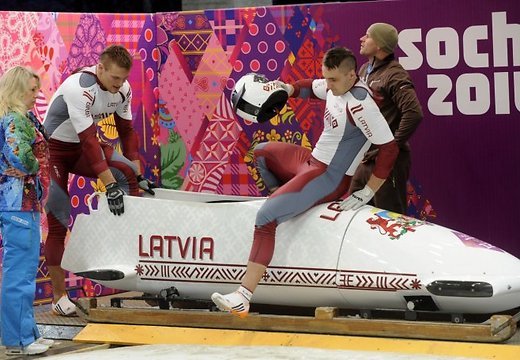
Bobsleigh Ornaments

A satisfying end to the Olympic run was when team Latvia’s bobsleigh team nabbed Silver on the last day. The bobsleighists had been a favourite and everyone had hopes for the team. They didn’t let us down, and just missed gold by a sliver.

But my rooting for the Latvian Bobsleigh team has a backstory, and…

View original post 553 more words

How the Media Isolate Academics: A Response to Nicholas Kristof

Nicholas Kristof usually produces thoughtful and insightful commentary in his columns in the New York Times. However, his recent article entitled “Professors, We Need You!” was such a lazy piece of writing that I found myself wondering whether his byline had been stuck on the column by mistake. The article trotted out very broad and very tired stereotypes of academic disciplines being too isolated from reality, and academics themselves being too wrapped up in their own self-serving work to engage with society or with the public.

Other blogging academics such as the political scientists at The Monkey Cage, the administrator at Confessions of a Community College Dean, and the scientist at Doing Good Science have already dissected the errors in Kristof’s article, along with pointing out the article’s failure to mention the structural, occupational and institutional factors creating the kind of academic work that Kristof denigrates. However, what I want to discuss is (more…)

Behind the Music (and Other Stuff): Creating a Skating Program

During the 2014 Winter Olympics, a lot more people than usual will be interested in figure skating. As an adult skater, I appreciate any attention that my sport gets –  but I also realize that occasional watchers don’t always know how much has to happen off the ice for skaters to look so good on the ice. So I thought I’d give some insight, from my own experiences, into how a competitive skating program is created. (more…)

“What Not to Buy” Update

I’m very happy to report that the nearly year-long strike at Labatt Breweries in St. John’s, NL, which I wrote about a few weeks ago, has ended.

The company and the union returned to collective bargaining with the aid of a conciliation officer, and the resulting collective agreement (more…)

More on Public Sector Sick Days “Abuse”

A few months ago I wrote about the Canadian Taxpayers Federation’s completely unsupported allegations of rampant sick day “abuse” by British Columbia’s public sector workers. Sadly, similar accusations have also been flying around (more…)

Some Thoughts on Sutton and Rao’s “Scaling Up Excellence”

I’ve written before about my general cynicism toward most business books. But one business book that I greatly admire – not only for its eye-catching title, but also for its sensible and forthright attitude – is Bob Sutton’s The No-Asshole Rule, which should be required reading for anyone involved in any aspect of hiring. Recently Bob offered “active influencers” preview copies of Scaling Up Excellence, the new book he has co-authored with his colleague Huggy Rao. When I saw the offer on Twitter, I thought, (more…)

The Rise of the Post-New Left Political Vocabulary

This is a fascinating analysis of how language and jargon have evolved across time in activist organizations. And it also demonstrates the influence that language has on organization members’ attitudes and perceptions (and vice versa).

stevedarcy's avatarThe Public Autonomy Project

[Click for Printable PDF]

If a handful of time-travelling activists from our own era were somehow transported into a leftist political meeting in 1970, would they even be able to make themselves understood? They might begin to talk, as present-day activists do, about challenging privilege, the importance of allyship, or the need for intersectional analysis. Or they might insist that the meeting itself should be treated as a safe space. But how would the other people at the meeting react? I’m quite sure that our displaced contemporaries would be met with uncomprehending stares.

It’s not so much that the words they use would be unfamiliar. Certainly ‘privilege’ is not a new word, for instance. But these newcomers to the 1970 Left would have a way of talking about politics and political action that would seem strange and off-kilter to the others at the meeting. If one of…

View original post 2,696 more words

Some Thoughts on Malcolm Gladwell’s “David and Goliath”

At last I got to the top of my public library’s waitlist for Malcolm Gladwell’s David and Goliath – so I finally had the chance this week to read the entire book.

The impression that I came away with was: this is not a good book.

It starts out promisingly by using the story of David and Goliath to introduce the idea of the triumph of the underdog. However, (more…)

A Great Introduction to Skating Choreography

http://www.youtube.com/watch?v=oGaB9FPPjnA

Anyone who wants to learn about choreography for competitive skating programs  should take a look at this excellent video, put together by American Ice Theatre. It uses examples from programs at the recent US national championships to demonstrate what a well-choreographed program includes, and what the judges are likely to be looking at in the choreography when they score a program. Thanks, AIT!

Stephen Colbert on Finding Joy in Your Work

The best five minutes of television in 2013 happened on August 7, when The Colbert Report aired a video of Stephen Colbert and “friends” dancing to Daft Punk’s song Get Lucky. Daft Punk had originally been scheduled to appear on the show in person – but they were also booked for the MTV Video Music Awards a few days later, and because of that MTV insisted that they not appear on Colbert’s show. So when Daft Punk cancelled, the video was quickly created to fill the sudden gap in the show’s schedule.

Because the video clearly involved considerable planning and effort, there was some skepticism after the broadcast about whether Colbert had actually made the video a few days earlier and then made up the cancellation story to get more attention for the video. In this podcast, hosted by comedian Paul Mecurio, Colbert gives a very thorough explanation of how the video came to be – which, as it turns out, is a rather complex story, involving what Daft Punk was and wasn’t willing to do, clashing corporate interests, and a lot of quick changes of strategy.

What struck me most about this interview (more…)