careers

University Diversity

Diversity in the workforce is a challenging issue for many organizations, but it’s particularly critical for universities. This is partly because many universities are publicly funded, which might imply that they have a larger responsibility to represent the population that financially supports them. And universities that teach about inclusivity and equality should surely be expected to live those values in their own operations.

But another reason is that universities are large and very visible organizations. Unlike workers at companies whose operations are largely unseen, workers at universities interact with large numbers of people – students, communities, governments – every day. So if there is a lack of diversity in the workforce at universities, it will be far more noticeable than it might be in other types of organizations.

Statistics Canada collects data on gender diversity among post-secondary instructors, but it doesn’t collect data on racial, ethnic or international diversity in that occupation. So I was very interested in (more…)

How I Promise You One of the Most Meaningful Days of Your Life — Both Sides of the Table – Medium

An incredibly inspirational post from venture capitalist Mark Suster, about a program giving entrepreneurial opportunities to prisoners.

I know the title “I promise you one of the most meaningful days of your life” sounds grandiose but I mean it and I hope you’ll read through to the end and choose to take one small, totally free action, that will change your life and likely those of others.On September 10th of this year I…

via How I Promise You One of the Most Meaningful Days of Your Life — Both Sides of the Table – Medium

The Olympics, Part I: Insights from Marc Kennedy

The 2016 Summer Olympics happened while the blog was on vacation. I have to admit that I had mixed feelings about the event, for many of the same reasons that were so eloquently expressed by fellow blogger Caitlin Constantine. And after the event ended, I read a very thoughtful and critical article which got me thinking about how the Olympics  affect the structure and funding of amateur sports in Canada.

So I’m going to write two posts related to the Olympics. This, the first post, is about a wonderful speech by an Olympic athlete that I heard earlier this year. The second, which I’ll post later on, is about how, while the Olympics are supposed to inspire people to get active, their effects on amateur sport may be making it more difficult for non-elite athletes to do that.

______________________________________

In June, I had the privilege of hearing a talk by world and Olympic champion curler Marc Kennedy.

This wasn’t the first time that I’ve been at a presentation by a high-achieving athlete. My cynical self was expecting a recycling of the usual themes in these speeches: “work hard”, ”have a dream”, ”fight through setbacks”, ”never give up”. But instead, Kennedy’s speech was a very insightful and honest look at the realities of performance at an elite level  – and a lot of what he said has relevance to work and to life, as well as to sports. These are the points from what Kennedy said that really stuck with me. (more…)

Graduate Degrees and Low-Wage Work

Underemployment is a phenomenon in the labour market that doesn’t get a lot of attention. That’s partly because the term “underemployment” can mean a couple of different things. One definition of “underemployment” is part-time workers who would prefer to be working full-time, or who are actively seeking full-time work while working part-time. Those situations aren’t always captured by measures that simply count the numbers of part-time workers, because those data don’t look at workers’ reasons why they are working part-time.

Another definition of “underemployment” is workers that have higher qualifications than the requirements of the job they’re employed in. This is also referred to as “overqualification”. And there’s a new study with some fascinating data about underemployment or overqualification among people with graduate degrees. (more…)

What unemployment at 63 looks like — Campari & Sofa

A very insightful look at one woman’s experience with late-career unemployment – a perspective that often gets overlooked in reports of corporate downsizing and layoffs.


“It feels like a divorce. 31 years with the same man and then you are abandoned for a younger woman.” The “man” in question is, in fact, a corporation; Mattel,…

via What unemployment at 63 looks like — Campari & Sofa

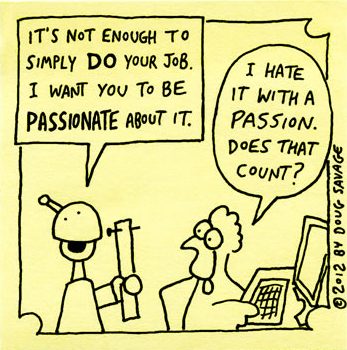
“Passion”

On networking sites like LinkedIn, and in biographies for keynote speakers – and in way too many other work-related contexts – it’s now almost obligatory for people to state their “passion”. However, these “passions” are, in many cases, so generic as to be meaningless – seriously, who doesn’t want to do something like make other people happy? And many statements of “passion” are often so jargon-laden that it’s difficult to tell exactly what the person gets excited about.

I was going to write a post about the awful superficiality of this expectation to be “passionate”. But then I came across a post on the same topic by Mark Manson. He says everything I was going to say – and he expresses it with genuine passion. Enjoy!


Conferences and Codes of Conduct

Nearly every organization has a code of conduct for its employees. These codes are usually explicit rules about what the organization’s members are and aren’t allowed to do, including the penalties – from reprimands to firing – for breaking those rules. Often there are also statements of the organization’s guiding values and principles, which employees are expected to uphold in carrying out their work or making decisions. But when employees go to professional events like conferences – events related to work but which take place outside the workplace – the rules of behaviour aren’t always as clear.

Behaviour at conferences is something that I’ve been thinking about as conference season is starting for me. Every year, away from the watchful eyes of their supervisors and their human resources department, some people act like idiots. They might do things like ask questions during a seminar or presentation with the sole intention of making the presenter look bad and making themselves look good. Or they might harass other conference attendees, usually at social events, by doing things like looking down women’s tops, making inappropriate comments about how someone is dressed, or uttering racist or sexist insults (I’ve personally witnessed all of these).

Surprisingly, though, many conference organizers are reluctant to crack down on these kinds of behaviours by attendees. (more…)

“Follow Your Heart”: An Interview with Jim Pons

The start of a new year, along with all the “New Year, New You” encouragement, usually leads people into thinking about making changes. One kind of change that’s often considered is a new job or a new occupation – but that can be a pretty scary leap into the unknown, especially when there’s cutbacks and downsizing going on at many formerly prosperous companies.

I thought that it would be interesting to interview someone who made that big leap and had it work out for them. After some asking around, my friend John Cody offered to connect me to Jim Pons, who is a wonderful example of this kind of career transition. Jim is a bass player and vocalist, and was part of three major bands in the 1960s and early 1970s – the Leaves, the Turtles,  and the Mothers of Invention. But he quit the music industry in 1973, and embarked on a career in video production with the National Football League, first with the New York Jets team and then with the Jacksonville Jaguars. Jim has recently written his autobiography, and generously agreed to be interviewed via email about his experiences in changing careers. (more…)

Feedback at Work

Giving feedback – to employees, peers, or even bosses – is a tricky but essential process in almost every organization. It’s important to let people know how they’re doing in their work, but it’s often difficult to figure out the best way to tell them, especially if there are problems with their performance.  And we all know organizations that loudly proclaim how much feedback and improvement are valued in their workplaces, but that don’t actually do much to make those processes happen.

My friend Allison Manley has recently starting hosting a podcast for Palantir.net, the web design, development and strategy firm where she works. The most recent episode of the podcast has a fascinating discussion on the topic of feedback. Allison talks with Colleen Carroll, Palantir’s director of operations, about Palantir’s commitment to having a “culture of feedback” and how the company actually makes that happen. What I found particularly interesting about this discussion is that it doesn’t repeat any of the usual clichés about feedback, like “focus on the problem, not the person”, and that it emphasizes the role of the sender of the feedback – a part of the process that often gets overlooked. Here are some of Colleen’s thoughtful insights into what makes feedback work. (more…)

Business Professors and Activism: An Interview with Scott Behson

Being neutral in academic work is something that I think many academics struggle with. I came to academia from journalism, so my experiences in journalism might have given me a heightened sensitivity of the importance of neutrality in writing and research. But research can never be entirely neutral or unbiased – if only for the simple reason that we tend to focus on topics that we personally find interesting or important.

However, I’ve noticed that business professors generally seem to interpret being neutral as staying away from any kind of activism – unless it’s something “safe” like joining the local chamber of commerce. I have to admit that when I first started spending time with professors from other academic disciplines, I was slightly shocked that some of them did things like testify at legislative hearings in support of or against proposed legislation, or serving as board members for advocacy groups. I thought, isn’t showing your opinion that strongly going to affect your credibility? But I gradually realized that academics can, and should, use their expertise to benefit society – especially if they can help those in society that struggle to be heard or to be treated fairly.

My frustration about the relative lack of advocacy in my own academic discipline made me especially excited to discover Scott Behson’s work. Scott is an activist who works to promote more family-friendly workplace practices, especially those that affect fathers – and he is also a professor of management in the Silberman College of Business at Fairleigh Dickinson University in New Jersey. Scott is the author of the book The Working Dad’s Survival Guide: How to Succeed at Work and at Home, which is an Amazon #1 best-seller in its categories, and which he describes as “the first book of its kind to provide advice and encouragement for working fathers, helping them to achieve success in their careers while also being the involved, loving dads they always wanted to be.” Scott is also a very active blogger, and has written for the Harvard Business Review Online, the Huffington Post, TIME, and The Wall Street Journal. He frequently appears in media, including MSNBC, NPR and Fox News; has worked with Fortune 500 companies as a consultant; and has been a keynote speaker at major events. Scott kindly agreed to let me interview him via email about his experiences as a business professor and an activist, and how he balances those two roles. (more…)