success

Graduate Degrees and Low-Wage Work

Underemployment is a phenomenon in the labour market that doesn’t get a lot of attention. That’s partly because the term “underemployment” can mean a couple of different things. One definition of “underemployment” is part-time workers who would prefer to be working full-time, or who are actively seeking full-time work while working part-time. Those situations aren’t always captured by measures that simply count the numbers of part-time workers, because those data don’t look at workers’ reasons why they are working part-time.

Another definition of “underemployment” is workers that have higher qualifications than the requirements of the job they’re employed in. This is also referred to as “overqualification”. And there’s a new study with some fascinating data about underemployment or overqualification among people with graduate degrees. (more…)

“Passion”

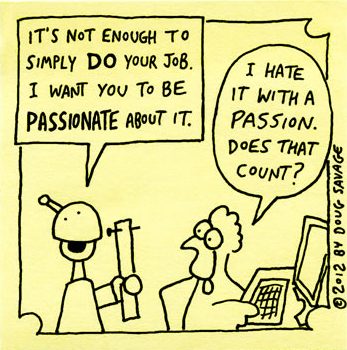
On networking sites like LinkedIn, and in biographies for keynote speakers – and in way too many other work-related contexts – it’s now almost obligatory for people to state their “passion”. However, these “passions” are, in many cases, so generic as to be meaningless – seriously, who doesn’t want to do something like make other people happy? And many statements of “passion” are often so jargon-laden that it’s difficult to tell exactly what the person gets excited about.

I was going to write a post about the awful superficiality of this expectation to be “passionate”. But then I came across a post on the same topic by Mark Manson. He says everything I was going to say – and he expresses it with genuine passion. Enjoy!


“Follow Your Heart”: An Interview with Jim Pons

The start of a new year, along with all the “New Year, New You” encouragement, usually leads people into thinking about making changes. One kind of change that’s often considered is a new job or a new occupation – but that can be a pretty scary leap into the unknown, especially when there’s cutbacks and downsizing going on at many formerly prosperous companies.

I thought that it would be interesting to interview someone who made that big leap and had it work out for them. After some asking around, my friend John Cody offered to connect me to Jim Pons, who is a wonderful example of this kind of career transition. Jim is a bass player and vocalist, and was part of three major bands in the 1960s and early 1970s – the Leaves, the Turtles,  and the Mothers of Invention. But he quit the music industry in 1973, and embarked on a career in video production with the National Football League, first with the New York Jets team and then with the Jacksonville Jaguars. Jim has recently written his autobiography, and generously agreed to be interviewed via email about his experiences in changing careers. (more…)

Business Professors and Activism: An Interview with Scott Behson

Being neutral in academic work is something that I think many academics struggle with. I came to academia from journalism, so my experiences in journalism might have given me a heightened sensitivity of the importance of neutrality in writing and research. But research can never be entirely neutral or unbiased – if only for the simple reason that we tend to focus on topics that we personally find interesting or important.

However, I’ve noticed that business professors generally seem to interpret being neutral as staying away from any kind of activism – unless it’s something “safe” like joining the local chamber of commerce. I have to admit that when I first started spending time with professors from other academic disciplines, I was slightly shocked that some of them did things like testify at legislative hearings in support of or against proposed legislation, or serving as board members for advocacy groups. I thought, isn’t showing your opinion that strongly going to affect your credibility? But I gradually realized that academics can, and should, use their expertise to benefit society – especially if they can help those in society that struggle to be heard or to be treated fairly.

My frustration about the relative lack of advocacy in my own academic discipline made me especially excited to discover Scott Behson’s work. Scott is an activist who works to promote more family-friendly workplace practices, especially those that affect fathers – and he is also a professor of management in the Silberman College of Business at Fairleigh Dickinson University in New Jersey. Scott is the author of the book The Working Dad’s Survival Guide: How to Succeed at Work and at Home, which is an Amazon #1 best-seller in its categories, and which he describes as “the first book of its kind to provide advice and encouragement for working fathers, helping them to achieve success in their careers while also being the involved, loving dads they always wanted to be.” Scott is also a very active blogger, and has written for the Harvard Business Review Online, the Huffington Post, TIME, and The Wall Street Journal. He frequently appears in media, including MSNBC, NPR and Fox News; has worked with Fortune 500 companies as a consultant; and has been a keynote speaker at major events. Scott kindly agreed to let me interview him via email about his experiences as a business professor and an activist, and how he balances those two roles. (more…)

“What Makes You Happy?”

My friend Kimbirli Macchiaverna has been a nurse for 20 years, and was a certified nursing assistant for a decade before that. Even though she works in an extremely challenging occupation – one with difficult demands and tasks that change every day – she has a great sense of humour and an unfailingly positive attitude toward life that I really admire.

A few weeks ago, Kimbirli wrote a Facebook post on the advice she gave to another nurse about “liking” her job even when it was tough. With Kimbirli’s permission, I’m reproducing her post here. Although her comments are in the context of nursing,  anyone in any kind of job can find something to think about in what she has to say. (more…)

The World Figure Championship: An Interview with Pamela Giangualano-Roberts

Two years ago, I wrote a blog post about figures in figure skating, and why I missed them. I thought the post wouldn’t be interesting to that many people – figures haven’t been part of international skating competition since 1990, and skaters now have very little opportunity to even practice figures. But much to my surprise, that post turned out to be one of the most popular posts ever on this blog. That indicated to me that within the skating world, and among skating fans, there was still a lot of love for figures.

This year, a group of professional skaters decided to bring figures back into competition, and organized the inaugural World Figure Championship. To qualify for this event, skaters either had to have competed at the Olympics or the World Championships before 1992, or had to have passed the gold (eighth) figure test, which was the highest-level figure test in the US and Canada. So, as you can imagine, all the participants were very experienced skaters, and the competition itself was intense. The Championship was held in late August in Lake Placid, New York – site of the 1932 and 1980 Winter Olympics – and my friend Pamela Giangualano-Roberts was one of the competitors.

I first met Pamela in the early 2000s in Lethbridge, Alberta, at one of the very first adults-only skating competitions in Canada. Pamela had come to the event with her skating friends from Calgary, and although she wasn’t competing, I could tell from how intently she watched us that she was thinking about whether she could do this. So I sat next to her and gave her my enthusiastic “skating is really fun, anyone can do it, you should give it a try” spiel. Imagine how stupid I felt later on when I found out that Pamela was the 1986 Canadian national junior ladies’ champion, and as a senior-level skater had represented Canada at international skating competitions. Pamela kindly overlooked that gaffe on my part, and she did come back to skating. And all of us adult skaters who know her are in awe of her drive and determination. At age 27 – much older than most of her competitors – she qualified for and competed at the 2002 Canadian national skating championships, 13 years after her last appearance at that event. She is now a tireless advocate for adult skating, as a coach, as an event organizer, as a club administrator, and as a skater herself.

Pamela agreed to let me interview her via email about her journey to the World Figure Championship, and her experiences at that competition. As you will see from her answers, Pamela not only has an extensive technical knowledge of figures, but she also truly appreciates why figures are so important to skating. (more…)
Overflow and Too Much Research


Can there be such a thing as too much research? And if there is, is that a good thing or a bad thing?

Two recent studies suggest that a lot of research is essential to the development of reliable knowledge. Replicating the results of other research studies is an important type of research, because that helps us figure out whether the original studies truly discovered something new, or whether those results were a fluke. And research studies that are variations on other studies – studies that change something from the original study, like an ingredient, or part of the study’s methodology – help us understand whether the results of the original study might apply in other settings or situations. So more research is definitely better than less research.

But another recent study has some very interesting observations on the effect of too much research on the researchers themselves. (more…)

Songwriters on Success

As much as I love music, the process of songwriting has always been a complete and utter mystery to me. I understand how to put words together, I understand how melodies and chords work, but combining all of those into something listenable is a skill I just don’t have. And I think that’s why I’m so interested in interviews with songwriters talking about their work.

I recently finished reading Jake Brown’s book Nashville Songwriter: The Inside Stories Behind Country Music’s Greatest Hits. I have to admit that I mostly stopped listening to country music around 2005 or so. I just got tired of artists that were pushed because of their looks rather than the quality of their music. And I was fed up with too many formulaic songs about trucks, beer and girls (or guys), and “country” songs that were substandard pop songs dressed up with a fiddle or lap steel guitar. So my choices for “country music’s greatest hits” would probably be quite different from Brown’s; here’s one that would definitely be on my list.

Because I don’t pay a lot of attention to country music any more, I don’t know all of the songs and artists that are mentioned in Brown’s interviews with 20 different songwriters. But nevertheless, the book was a fascinating read – and I found it particularly interesting that (more…)

“Why I F***ing Hate Unicorns and the Culture They Breed”

Short cuts are one path to success, but they’re a very perilous path. And when a short-cut mentality starts to dominate an industry like tech startups, it not only threatens the stability of the entire industry – it also downplays the reality of the day-to-day gruntwork that builds a sustainable, solid product. In the words of venture capitalist Mark Suster,

I blame unicorns. Not the successful companies themselves but the entire bullshit culture of swash-buckling startups who define themselves by hitting some magical $1 billion valuation number and the financiers who back them irrespective of metrics that justify it. Unicorn has become part of our lexicon in a sickening way and will no doubt become part of the history we tell about how things got so out of control again….

Victory on the field is more often a result of three yards and a cloud of dust. I like that. So, too, startups. It’s not about being on stage at a Demo Day or featured in an article in TechCrunch or closing a $20 million round. It’s about continually shipping code. It’s about putting out menacing bugs. It’s about a 6:15am flight to a customer in Detroit in Winter for a $200k deal to hit your budget for the quarter….

It’s really about love. And sacrifice. And hard work. And putting in the daily things that it takes to achieve great things. And how in the daily routine of being yourself, committing to goals and just living life, you realize that goals were easier to obtain than you had imagined.

Suster expresses his frustration in this brilliant blog post. Please read the whole thing – it’s worth your time.

(H/t Allison Manley)

A Tribute to Bill Watterson’s Perspective on Success

The work of cartoonist Bill Watterson is widely loved and respected, but Watterson has had a most unconventional career path. His comic strip Calvin and Hobbes was one of the most successful cartoons of the late 1980s and early 1990s – but Watterson resisted all attempts to commercialize the strip and its characters. No animated movie, no TV series, no stuffed toys or other merchandise. And when Watterson felt the comic strip had “said all it had to say”, he graciously ended it. Other than a few unexpected projects and guest appearances since then – like in 2014,  when Watterson anonymously took over a week of Stephan Pastis’ comic strip Pearls Before Swine – Watterson has worked on whatever he wants to, whenever he feels like it, and stayed out of the public eye.

One of my friends showed me this comic by artist Gavin Aung Than, who runs a website called Zen Pencils. Than was frustrated with working in corporate graphic design, and quit his job to create a career in what he found personally rewarding: choosing inspirational quotes and drawing cartoons to illustrate them. Zen Pencil is a wonderful site; the quotes are carefully selected, and Than’s artwork is astounding – especially when he is illustrating the words of another artist (Calvin and Hobbes fans will recognize the visual reference in the last panel of this comic). Than’s commentary on his Watterson comic explains very eloquently why Watterson’s work is so highly regarded by other cartoonists, and why Than personally was inspired in his work by Watterson’s unconventional choices. Here’s Watterson’s words and Than’s images, in a beautiful and profound commentary on what “success” really looks like. (more…)