work

Letting the Sunshine In

How much light should a “sunshine list” shine?

Public sector compensation disclosure lists – “sunshine lists” – are lists of individuals in public sector jobs that are paid more than a certain amount. These annual lists usually include the person’s name, the public sector organization they work for, their job title, and their annual earnings for that fiscal year.  In Canada, five provinces have some version of a legislated “sunshine list”: Alberta, Nova Scotia, Ontario, Saskatchewan, and New Brunswick. (Other provinces publish salary information in their public accounts, but don’t produce a single comprehensive list.)

The reasons for publishing these lists usually involve “accountability” and “transparency” – but recently there has been pushback from some of the workers included on the lists. (more…)

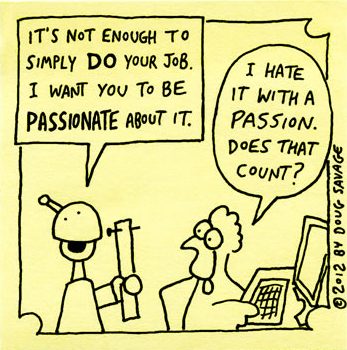
“Passion”

On networking sites like LinkedIn, and in biographies for keynote speakers – and in way too many other work-related contexts – it’s now almost obligatory for people to state their “passion”. However, these “passions” are, in many cases, so generic as to be meaningless – seriously, who doesn’t want to do something like make other people happy? And many statements of “passion” are often so jargon-laden that it’s difficult to tell exactly what the person gets excited about.

I was going to write a post about the awful superficiality of this expectation to be “passionate”. But then I came across a post on the same topic by Mark Manson. He says everything I was going to say – and he expresses it with genuine passion. Enjoy!


Misreading the Environment, Part II

Nearly four years ago, I wrote this blog post about how the Globe and Mail newspaper responsed to allegations that columnist Margaret Wente had used uncredited sources in some of her writing. In that post, I talked about the model of population ecology, from organizational theory. The model suggests that if an organization wants to be considered legitimate, and to gain benefits of legitimacy such as resources and power, then it needs to monitor cues in its external environment, and respond to those cues in ways that the environment considers appropriate.

Wente was briefly suspended after those 2012 allegations, but returned to her job. This past week, the same blogger that found problems with Wente’s work in 2012 found uncredited material from other sources in Wente’s most recent column. The Globe‘s response to these findings was to publish a column by its public editor.  The column quoted the Globe‘s editor-in-chief as saying the paper would “work with Peggy to ensure this cannot happen again”, and that there would be apologies and corrections to the uncredited material.

After that, in Lewis Carroll’s words, “answer came there none” – despite (more…)

Sigh…..

Mansplaining Event at PayPal via Francine Lipman (@Narfnampil) Feminist Law Professors

via Mansplaining Event at PayPal — Feminist Law Professors

Conferences and Codes of Conduct

Nearly every organization has a code of conduct for its employees. These codes are usually explicit rules about what the organization’s members are and aren’t allowed to do, including the penalties – from reprimands to firing – for breaking those rules. Often there are also statements of the organization’s guiding values and principles, which employees are expected to uphold in carrying out their work or making decisions. But when employees go to professional events like conferences – events related to work but which take place outside the workplace – the rules of behaviour aren’t always as clear.

Behaviour at conferences is something that I’ve been thinking about as conference season is starting for me. Every year, away from the watchful eyes of their supervisors and their human resources department, some people act like idiots. They might do things like ask questions during a seminar or presentation with the sole intention of making the presenter look bad and making themselves look good. Or they might harass other conference attendees, usually at social events, by doing things like looking down women’s tops, making inappropriate comments about how someone is dressed, or uttering racist or sexist insults (I’ve personally witnessed all of these).

Surprisingly, though, many conference organizers are reluctant to crack down on these kinds of behaviours by attendees. (more…)

“Follow Your Heart”: An Interview with Jim Pons

The start of a new year, along with all the “New Year, New You” encouragement, usually leads people into thinking about making changes. One kind of change that’s often considered is a new job or a new occupation – but that can be a pretty scary leap into the unknown, especially when there’s cutbacks and downsizing going on at many formerly prosperous companies.

I thought that it would be interesting to interview someone who made that big leap and had it work out for them. After some asking around, my friend John Cody offered to connect me to Jim Pons, who is a wonderful example of this kind of career transition. Jim is a bass player and vocalist, and was part of three major bands in the 1960s and early 1970s – the Leaves, the Turtles,  and the Mothers of Invention. But he quit the music industry in 1973, and embarked on a career in video production with the National Football League, first with the New York Jets team and then with the Jacksonville Jaguars. Jim has recently written his autobiography, and generously agreed to be interviewed via email about his experiences in changing careers. (more…)

Feedback at Work

Giving feedback – to employees, peers, or even bosses – is a tricky but essential process in almost every organization. It’s important to let people know how they’re doing in their work, but it’s often difficult to figure out the best way to tell them, especially if there are problems with their performance.  And we all know organizations that loudly proclaim how much feedback and improvement are valued in their workplaces, but that don’t actually do much to make those processes happen.

My friend Allison Manley has recently starting hosting a podcast for Palantir.net, the web design, development and strategy firm where she works. The most recent episode of the podcast has a fascinating discussion on the topic of feedback. Allison talks with Colleen Carroll, Palantir’s director of operations, about Palantir’s commitment to having a “culture of feedback” and how the company actually makes that happen. What I found particularly interesting about this discussion is that it doesn’t repeat any of the usual clichés about feedback, like “focus on the problem, not the person”, and that it emphasizes the role of the sender of the feedback – a part of the process that often gets overlooked. Here are some of Colleen’s thoughtful insights into what makes feedback work. (more…)

Employee Engagement Surveys (And Doing Them Well)

2015 was a really bad year for the Canadian Broadcasting Corporation (CBC). At the start of the year, business correspondent Amanda Lang was accused of being in a conflict of interest for her reporting on an issue involving the Royal Bank of Canada while having a personal relationship with a RBC executive. (Lang later left the CBC for a new job with Bloomberg TV.) Then radio host Jian Ghomeshi lost his job because of incidents that resulted in him being charged with one count of choking and five counts of sexual assault – and CBC management’s awkward handling of that situation led to the firing of two top executives. And then TV host Evan Solomon was fired after allegations that he exploited his work-related connections to sell high-priced artworks. (He found a new job on satellite radio and as a magazine columnist.)

There was one bright spot for the CBC in October when the decidedly anti-CBC Conservative party was defeated in the Canadian federal election. The potential for change in the CBC’s relationship with Canada’s federal government, which funds the CBC’s operations, was characterized by retired CBC journalist Linden MacIntyre as “the people that are the custodians of this publicly owned institution no longer seem[ing] to hate it” – but the CBC is still struggling with the fallout from the traumatic events that marred its reputation in the past year.

An external review of the CBC workplace was commissioned after (more…)

This is What We Lose

The new film Spotlight tells the story of an investigation by a team of reporters at the Boston Globe newspaper in the early 2000s. The reporters documented extensive child abuse by priests and brothers in the Catholic Archdiocese of Boston. Their investigation also exposed a cover-up by church officials, who knew that widespread abuse had been happening for several decades but failed to do anything meaningful to stop it.

I saw Spotlight this week, and I highly recommend it. It’s a fascinating and engaging film. And as a former newspaper reporter, I thought the film very realistically depicted the work of reporting, especially in showing the amount of legwork and detailed research that goes into writing a major news story. It also illustrated the often-overlooked contexts within which news stories develop – in this case, the elites in Boston society that helped to keep the abuse hidden, and that also discouraged the Globe from pursuing the story.

However, as much as I enjoyed Spotlight, it also made me feel very sad – because (more…)

Business Professors and Activism: An Interview with Scott Behson

Being neutral in academic work is something that I think many academics struggle with. I came to academia from journalism, so my experiences in journalism might have given me a heightened sensitivity of the importance of neutrality in writing and research. But research can never be entirely neutral or unbiased – if only for the simple reason that we tend to focus on topics that we personally find interesting or important.

However, I’ve noticed that business professors generally seem to interpret being neutral as staying away from any kind of activism – unless it’s something “safe” like joining the local chamber of commerce. I have to admit that when I first started spending time with professors from other academic disciplines, I was slightly shocked that some of them did things like testify at legislative hearings in support of or against proposed legislation, or serving as board members for advocacy groups. I thought, isn’t showing your opinion that strongly going to affect your credibility? But I gradually realized that academics can, and should, use their expertise to benefit society – especially if they can help those in society that struggle to be heard or to be treated fairly.

My frustration about the relative lack of advocacy in my own academic discipline made me especially excited to discover Scott Behson’s work. Scott is an activist who works to promote more family-friendly workplace practices, especially those that affect fathers – and he is also a professor of management in the Silberman College of Business at Fairleigh Dickinson University in New Jersey. Scott is the author of the book The Working Dad’s Survival Guide: How to Succeed at Work and at Home, which is an Amazon #1 best-seller in its categories, and which he describes as “the first book of its kind to provide advice and encouragement for working fathers, helping them to achieve success in their careers while also being the involved, loving dads they always wanted to be.” Scott is also a very active blogger, and has written for the Harvard Business Review Online, the Huffington Post, TIME, and The Wall Street Journal. He frequently appears in media, including MSNBC, NPR and Fox News; has worked with Fortune 500 companies as a consultant; and has been a keynote speaker at major events. Scott kindly agreed to let me interview him via email about his experiences as a business professor and an activist, and how he balances those two roles. (more…)