sports

The Dark Side of Workplace Wellness

The Report on Business section of the Globe and Mail newspaper recently ran an interview with the authors of a provocative new book, The Wellness Syndrome. The authors, Carl Cederstrom and Andre Spicer,  argue that the ideal of “wellness” has become distorted into a “dangerous ideology”. Promoting “wellness” as a virtue, they suggest, implicitly promotes discrimination against those who have difficulty being “well”, such as people with chronic weight or health issues. And framing “wellness” as an individual issue deflects attention from larger societal conditions, such as poverty, that have much more impact on an individual’s health than their individual choices. (For example, it’s hard to get regular outdoor exercise if you live in an unsafe neighbourhood, or to eat well if the stores in your area don’t stock healthy, affordable food.)

The authors’ perspectives make a lot of sense. And, I would argue, their take on the misuse of “wellness” is also applicable to many “workplace wellness” initiatives.  There are good employers with sincere intentions who run “workplace wellness” programs because they genuinely care about their employees’ well-being. But there are other, less admirable aspects to some of these programs. (more…)

D.F.L. (Dead F***ing Last)

When you look at competition results, there are several acronyms that you might see next to athletes’ names, such as DNQ (did not qualify), DNF (did not finish), and WD (withdrew). But there’s also an unofficial acronym, and it represents a placement that most competitors will experience at least once in their careers. That acronym is DFL – dead f***ing last.

In the “winning is everything” ethos of competing, DFLing is something to be ashamed of, to avoid, to move on from. We assume that the DFLer choked, or didn’t train hard enough, or shouldn’t have entered the event in the first place. Sometimes we celebrate DFLers for their persistence and determination, like ski jumper Eddie the Eagle at the 1988 Winter Olympics. But more often than not DFLing is an embarrassment, and the only response that’s considered appropriate from the DFLer is either to quit competing or to work extra hard so as not to finish last again.

However, there’s another way to think about DFLs. As described in a recent article by runner Lauren Fleshman, a DFL placing can turn out to be (more…)

A Step Forward

As an adult figure skater, and an avid skating fan, the world figure skating championships are always an incredibly exciting event for me to watch. The 2015 world championships in March were particularly interesting, because they were the first world championships of the four years leading up to the 2018 Olympics. As usually happens after every Olympics, many recent world and Olympic competitors have retired or have decided to take a break from competition. So the 2015 world championships were one of the first opportunities for skaters to begin establishing themselves as potential contenders for 2018.

But something else important occurred at the 2015 world figure skating championships. It’s something that didn’t get a lot of attention in the media, but it should be acknowledged. And that’s the fact that Eric Radford, who won the pairs event with his partner Meagan Duhamel, is the first openly gay skater to win a world championship. (more…)

What Skating Judging can Learn from Workplace Performance Evaluation

At every Winter Olympics, it seems, there are complaints about figure skating judging. Occasionally those complaints lead to something more – as in 2002, when a second gold medal was awarded in the pairs event because of alleged bias in the judging. But usually the complaints are along the lines of “The judging was unfair because my favourite skater lost”, or “The judging was unfair because I didn’t understand it” – that second one often coming from sportswriters and commentators who don’t regularly follow figure skating, or who can’t be bothered to learn how the judging system works.

At the 2014 Sochi Olympics, there were complaints about the judging in every one of the figure skating events, including allegations of fixed results in at least two of the events.  The purpose of this post isn’t to argue about those results. Instead, I want to look at the judging system itself, and analyze it using the model of an effective workplace performance evaluation system. I’m using this model for two reasons: (more…)

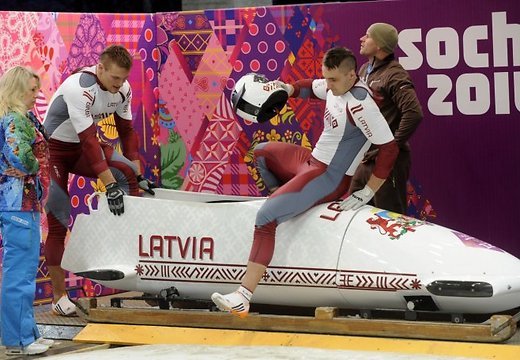
How Latvian Mythology Contributed to the Olympic Silver in Bobsleigh

Fascinating insights from the designer of the graphics on Latvia’s Olympic bobsleds. And how great is it that all that attention to detail helped the Latvian bobsled team win a medal!!

Julia Gifford's avatarFood, writing, random musings, and everything I enjoy

These past Olympics have been mind-blowing for the Latvians. A very small country, with the third most medals per capita of all participating countries, Latvia also managed to induce partial heart attacks to 35million Canadians with the show-stopping Canada vs. Latvia hockey game, drawing all eyes on Latvia (similarly to the last summer Olympics when Latvia won gold in men’s Volleyball – “Wait, do they even have summer?”)

Edit: not gold in volleyball, bet bronze in beach volleyball, beating the US team in the quarter finals. Thanks to the readers that spotted that mistake!

Bobsleigh Ornaments

A satisfying end to the Olympic run was when team Latvia’s bobsleigh team nabbed Silver on the last day. The bobsleighists had been a favourite and everyone had hopes for the team. They didn’t let us down, and just missed gold by a sliver.

But my rooting for the Latvian Bobsleigh team has a backstory, and…

View original post 553 more words

Behind the Music (and Other Stuff): Creating a Skating Program

During the 2014 Winter Olympics, a lot more people than usual will be interested in figure skating. As an adult skater, I appreciate any attention that my sport gets –  but I also realize that occasional watchers don’t always know how much has to happen off the ice for skaters to look so good on the ice. So I thought I’d give some insight, from my own experiences, into how a competitive skating program is created. (more…)

A Great Introduction to Skating Choreography

Anyone who wants to learn about choreography for competitive skating programs  should take a look at this excellent video, put together by American Ice Theatre. It uses examples from programs at the recent US national championships to demonstrate what a well-choreographed program includes, and what the judges are likely to be looking at in the choreography when they score a program. Thanks, AIT!

Caring, Not Caring, And Success

I’ve just finished reading David Epstein’s excellent book The Sports Gene, a fascinating exploration of the research on genetic and physiological factors that may contribute to exceptional athletic performance. Ironically, I got the book only a few weeks before I saw the fascinating Alex Gibney documentary The Armstrong Lie, which was intended to be about Lance Armstrong‘s 2009 return to competitive cycling in the Tour de France, but instead ended up being about Armstrong’s secret use of performance-enhancing drugs. Clearly anyone who takes PEDs is trying to gain a physiological advantage in competition, but watching Armstrong’s behaviour in the film made me wonder about another factor in exceptional athletic performance: (more…)

The Joy of Figures

Over the past two weeks, the international competitive ice skating season has started, with the Skate America competition in Detroit and the Skate Canada competition in Saint John. In most countries, the local and regional competitions leading to national championships are also underway – and all these events are more intensely competitive than usual because of the upcoming 2014 Olympic Winter Games in Sochi, Russia. But I’m going to talk about a part of skating that sadly disappeared from (more…)

Malcolm Gladwell’s Weak Defense of the “10,000 Hour Rule”

The “10,000 hour rule” – the idea that 10,000 hours of practice is the amount needed to excel in an activity, as described in Malcolm Gladwell’s 2008 book Outliers – has been getting more attention than usual recently. The attention is partly because of the release of Gladwell’s new book, David and Goliath, but it’s also because of the discussion of the rule in another new book –  The Sports Gene, by former Sports Illustrated senior writer David Epstein. In his investigation of what leads to outstanding athletic performance, Epstein points out some contradictions to Gladwell’s rule – for example, that athletes at the same level of competition can have very different amounts of practice time or playing experience, and that success in sports isn’t determined only by how much an athlete practices.

A few weeks ago, in this article in the New Yorker, Gladwell responded to Epstein and to other critics of the “10,000 hour rule”.  Since I’ve written a blog post about Gladwell’s misinterpretations of the research cited in Outliers in support of the rule, I was very interested in what Gladwell had to say. But it seems that the article is full of  (more…)