success

Dismantling the Creative Routine

Around this time last year,  Thomas Frank put forward some very pointed and accurate criticisms of the popular literature about creativity – namely, that these books and articles discussed the same examples over and over again – and wondered how much this literature could really enlighten us about creativity when it was so un-creative itself.

Now an article in Pacific Standard magazine has similarly critical things to say about another frequently discussed aspect of creativity – the “creative routine”. This, we are told, (more…)

On Commencement, and Moving Forward

In my work, it’s the time of year on campus when things are gearing up for graduation. I’ve sat through graduation ceremonies as a graduating student and as a faculty member, and I have some painful memories of very tedious, long-winded speakers who spouted cliche after cliche. But I’ve also been privileged to hear great speakers like author Antonine Maillet; at the ceremony where I received my MBA, she gave a beautiful address that was like being told an enchanting tale about the power and magic of books.

Stephen Colbert isn’t graduating from university this year, but, (more…)

What Skating Judging can Learn from Workplace Performance Evaluation

At every Winter Olympics, it seems, there are complaints about figure skating judging. Occasionally those complaints lead to something more – as in 2002, when a second gold medal was awarded in the pairs event because of alleged bias in the judging. But usually the complaints are along the lines of “The judging was unfair because my favourite skater lost”, or “The judging was unfair because I didn’t understand it” – that second one often coming from sportswriters and commentators who don’t regularly follow figure skating, or who can’t be bothered to learn how the judging system works.

At the 2014 Sochi Olympics, there were complaints about the judging in every one of the figure skating events, including allegations of fixed results in at least two of the events.  The purpose of this post isn’t to argue about those results. Instead, I want to look at the judging system itself, and analyze it using the model of an effective workplace performance evaluation system. I’m using this model for two reasons: (more…)

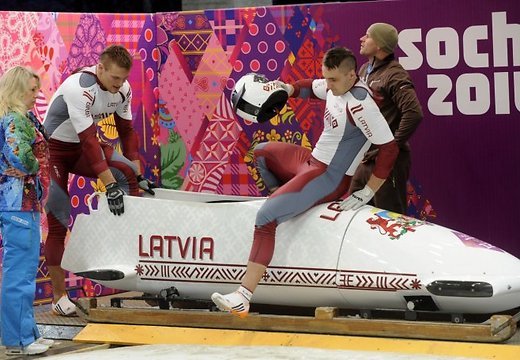
How Latvian Mythology Contributed to the Olympic Silver in Bobsleigh

Fascinating insights from the designer of the graphics on Latvia’s Olympic bobsleds. And how great is it that all that attention to detail helped the Latvian bobsled team win a medal!!

Julia Gifford's avatarFood, writing, random musings, and everything I enjoy

These past Olympics have been mind-blowing for the Latvians. A very small country, with the third most medals per capita of all participating countries, Latvia also managed to induce partial heart attacks to 35million Canadians with the show-stopping Canada vs. Latvia hockey game, drawing all eyes on Latvia (similarly to the last summer Olympics when Latvia won gold in men’s Volleyball – “Wait, do they even have summer?”)

Edit: not gold in volleyball, bet bronze in beach volleyball, beating the US team in the quarter finals. Thanks to the readers that spotted that mistake!

Bobsleigh Ornaments

A satisfying end to the Olympic run was when team Latvia’s bobsleigh team nabbed Silver on the last day. The bobsleighists had been a favourite and everyone had hopes for the team. They didn’t let us down, and just missed gold by a sliver.

But my rooting for the Latvian Bobsleigh team has a backstory, and…

View original post 553 more words

Some Thoughts on Malcolm Gladwell’s “David and Goliath”

At last I got to the top of my public library’s waitlist for Malcolm Gladwell’s David and Goliath – so I finally had the chance this week to read the entire book.

The impression that I came away with was: this is not a good book.

It starts out promisingly by using the story of David and Goliath to introduce the idea of the triumph of the underdog. However, (more…)

Stephen Colbert on Finding Joy in Your Work

The best five minutes of television in 2013 happened on August 7, when The Colbert Report aired a video of Stephen Colbert and “friends” dancing to Daft Punk’s song Get Lucky. Daft Punk had originally been scheduled to appear on the show in person – but they were also booked for the MTV Video Music Awards a few days later, and because of that MTV insisted that they not appear on Colbert’s show. So when Daft Punk cancelled, the video was quickly created to fill the sudden gap in the show’s schedule.

Because the video clearly involved considerable planning and effort, there was some skepticism after the broadcast about whether Colbert had actually made the video a few days earlier and then made up the cancellation story to get more attention for the video. In this podcast, hosted by comedian Paul Mecurio, Colbert gives a very thorough explanation of how the video came to be – which, as it turns out, is a rather complex story, involving what Daft Punk was and wasn’t willing to do, clashing corporate interests, and a lot of quick changes of strategy.

What struck me most about this interview (more…)

Caring, Not Caring, And Success

I’ve just finished reading David Epstein’s excellent book The Sports Gene, a fascinating exploration of the research on genetic and physiological factors that may contribute to exceptional athletic performance. Ironically, I got the book only a few weeks before I saw the fascinating Alex Gibney documentary The Armstrong Lie, which was intended to be about Lance Armstrong‘s 2009 return to competitive cycling in the Tour de France, but instead ended up being about Armstrong’s secret use of performance-enhancing drugs. Clearly anyone who takes PEDs is trying to gain a physiological advantage in competition, but watching Armstrong’s behaviour in the film made me wonder about another factor in exceptional athletic performance: (more…)

The Joy of Figures

Over the past two weeks, the international competitive ice skating season has started, with the Skate America competition in Detroit and the Skate Canada competition in Saint John. In most countries, the local and regional competitions leading to national championships are also underway – and all these events are more intensely competitive than usual because of the upcoming 2014 Olympic Winter Games in Sochi, Russia. But I’m going to talk about a part of skating that sadly disappeared from (more…)

Malcolm Gladwell’s Weak Defense of the “10,000 Hour Rule”

The “10,000 hour rule” – the idea that 10,000 hours of practice is the amount needed to excel in an activity, as described in Malcolm Gladwell’s 2008 book Outliers – has been getting more attention than usual recently. The attention is partly because of the release of Gladwell’s new book, David and Goliath, but it’s also because of the discussion of the rule in another new book –  The Sports Gene, by former Sports Illustrated senior writer David Epstein. In his investigation of what leads to outstanding athletic performance, Epstein points out some contradictions to Gladwell’s rule – for example, that athletes at the same level of competition can have very different amounts of practice time or playing experience, and that success in sports isn’t determined only by how much an athlete practices.

A few weeks ago, in this article in the New Yorker, Gladwell responded to Epstein and to other critics of the “10,000 hour rule”.  Since I’ve written a blog post about Gladwell’s misinterpretations of the research cited in Outliers in support of the rule, I was very interested in what Gladwell had to say. But it seems that the article is full of  (more…)

A Journey Through The Peer Review Process

A few months ago I wrote this post about the problem of hidden bias in the peer review process at academic journals. Anyone who read that post, or who wants to know more about the process of getting academic researched published in journals, should check out this very informative and enlightening post by political scientist Nate Jensen. It took nearly five years, and rejections by four journals, for his award-winning paper to get accepted for publication.

Among my own colleagues, the longest time it took anyone to get an article published (at least that I’m aware of) was four years – and that was from submission to acceptance at one journal. Success in academic work requires a lot of qualities, but clearly patience and persistence are among the most important.

(Thanks to The Monkey Cage blog, where I found the post that led me to Nate’s story.)